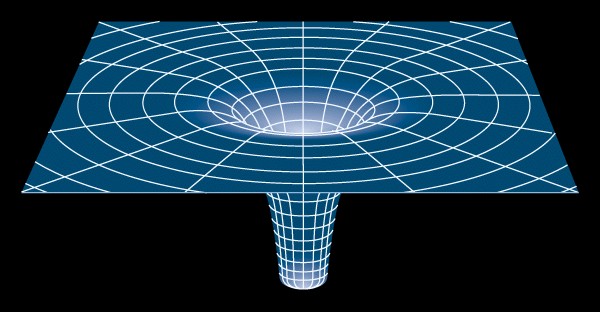
- Black holes do not "suck" things in. Suction is pulling something into a vacuum, which black holes do not. Instead, things "fall" into black holes.
- Graham's Number is a possible solution to a problem involving n-dimensional hypercubes. Graham's Number is so large that it exceeds the maximum about of entropy that a brain-sized space could hold. So if you were to fully comprehend all the numbers in Graham's Number, your brain would collapse in on itself and form a black hole.
- Black holes bend the space and time around them, so the closer you get to a black hole, the slower time goes.
- There are over 100 million black holes in the Milky Way alone. Being that there are 100 billion galaxies, black holes are littered all over the universe.
- Astronomers theorize that there may be tiny black holes formed seconds after the Big Bang. Some of these black holes can be the size of an atom, although they have yet to be observed.
- The Schwarzchild Radius is the size something would need to be compressed into to form a black hole. The Earth has a Schwarzchild Radius of a couple inches.
- The process of being stretched in a black hole is called "spaghettification".
- Over time, black holes evaporate due to Hawking Radiation. However, this process takes a very long time and is usually countered by the black hole consuming mass from objects falling in.
- The nearest black hole from Earth is 1,600 light years away.
- Black holes spin rapidly. As the core of a star collapses, it rotates faster and faster while becoming smaller. If it doesn't have the mass to become a black hole, it squeezes together to form a neutron star and continues spinning. The same goes for black holes.